
Choosing the right process affects your part's cost, lead time, tolerance and overall quality, so it's worth understanding what actually separates the two before you send out an RFQ.
This guide breaks down how 3 axis and 5 axis CNC machining differ, when each is the right choice, and how to decide which process fits your project.
What Is 3 Axis CNC Machining?
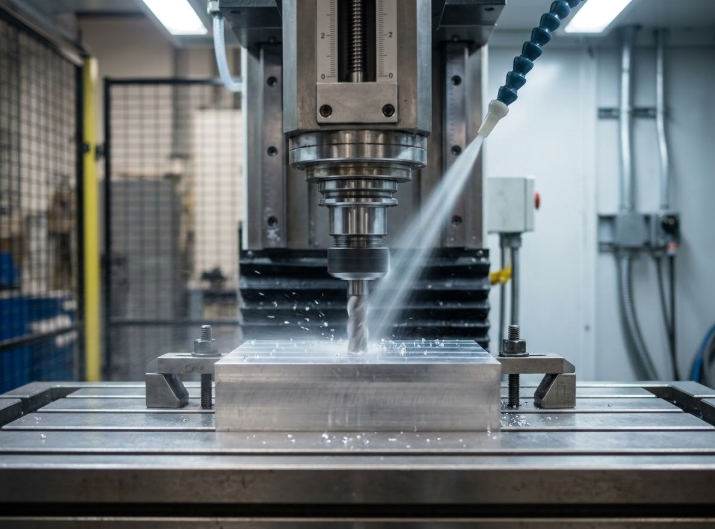
A 3 axis CNC machine moves the cutting tool along three linear axes — X, Y and Z. The workpiece stays fixed relative to the machine table while the tool moves across its length, width and depth. This is the most common and widely available form of CNC milling, and it is well suited to parts that are largely flat or prismatic in shape — brackets, plates, blocks and housings with features accessible from a small number of orientations.
Because the tool can only approach the workpiece from directions aligned with these three axes, any features on other faces of the part require the operator to stop, reposition or refixture the workpiece, and re-establish the machine's reference point before continuing.
What Is 5 Axis Machining?
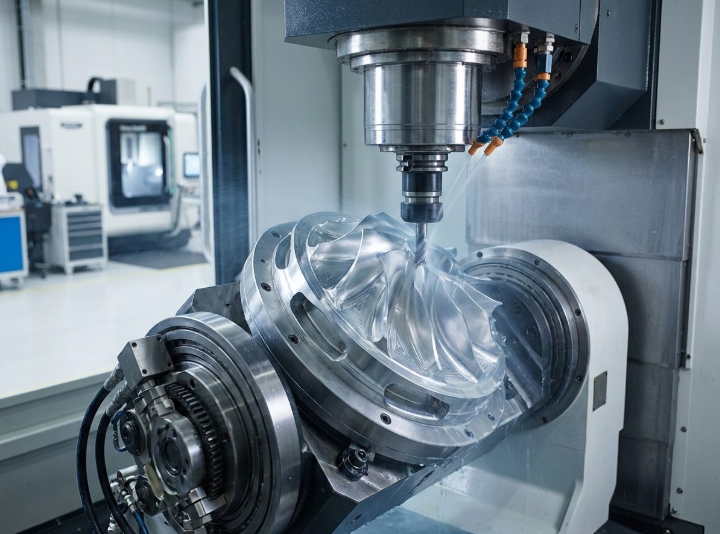
5 axis machining adds two rotational axes to the standard X, Y and Z linear axes — typically labelled A and B, or A and C, depending on the machine configuration. This allows the cutting tool and workpiece to be oriented relative to each other at virtually any angle, so multiple faces and complex contoured surfaces can be machined without physically repositioning the part.
There are two common modes of 5 axis operation: 3+2 machining (also called 5-axis positioning), where the machine locks into a fixed angle to machine a feature and then repositions for the next, and true simultaneous 5 axis machining, where all five axes move together continuously to cut complex curved surfaces such as turbine blades or organic, sculpted geometries.
Key Differences Between 3 Axis and 5 Axis Machining
The two processes differ across several practical dimensions that matter to anyone sourcing parts:
Number of setups — 3 axis machining often requires multiple setups to reach different faces of a part; 5 axis machining can complete most or all features in a single setup.
Accuracy and tolerance — fewer setups mean less cumulative alignment error, so 5 axis machining generally holds tighter relational tolerances between features on different faces.
Part complexity — 5 axis machining can produce compound angles, undercuts and contoured surfaces that are difficult or impossible to reach with a 3 axis machine.
Surface finish — simultaneous 5 axis toolpaths can produce smoother, more consistent surface finishes on curved geometry compared with the stepped finish that can result from repositioning on a 3 axis machine.
Machine and programming cost — 5 axis machines and the CAM programming required to run them are more specialised and typically carry a higher hourly rate.
Lead time per part — while 5 axis machines cost more per hour, eliminating multiple setups can reduce total cycle time for complex parts, sometimes offsetting the higher rate.
When to Use 3 Axis CNC Machining
3 axis machining remains the right choice for a large share of machined parts, particularly where:
The part geometry is largely flat, prismatic or has features accessible from one or two orientations.
Tolerances are standard rather than extremely tight across multiple faces.
Budget and lead time are a priority and the part doesn't justify the added cost of 5 axis capability.
Production volumes are high and the part has already been optimised for efficient 3 axis production.
Typical examples include mounting brackets, enclosure panels, spacers, simple housings and many turned components.
When 5-Axis Machining Is the Better Choice
5 axis machining earns its higher rate when a part genuinely needs the capability. Common indicators include:
Compound angles or features on multiple non-parallel faces that would otherwise require several setups.
Curved, contoured or organic surfaces, such as aerodynamic components or medical implants.
Undercuts or deep pockets at an angle that a 3 axis tool cannot reach without a specialised fixture.
Tight positional tolerances between features located on different faces of the part.
Thin-walled or delicate parts where repeated refixturing risks distortion or damage.
Industries such as aerospace, medical devices, mould and die tooling, and precision preformer die manufacturing rely heavily on 5 axis machining for exactly these reasons.
Cost & Lead Time Considerations
It's a common misconception that 5 axis machining is simply more expensive across the board. While the hourly machine rate is typically higher, the total cost of a complex part can actually be lower on a 5 axis machine once you account for the setup time, fixturing and potential rework that multiple 3 axis setups would require.
For simple parts, however, 3 axis machining almost always remains the more economical option — the added capability of a 5 axis machine brings no benefit if the geometry doesn't need it.
How to Decide Which Process Fits Your Project
A quick way to assess which process your part needs is to ask:
Can all critical features be reached and held to tolerance from no more than two orientations? → 3 axis is likely sufficient.
Does the part have curved or angled surfaces, undercuts, or tight tolerances spanning multiple faces? → 5 axis machining is likely the better fit.
Is this a low-volume, high-complexity part where reducing setups meaningfully improves accuracy and turnaround? → 5 axis machining often pays for itself.
If you're unsure, sharing your CAD model and drawing with a machining partner is the fastest way to get a definitive recommendation, along with a quote reflecting the most efficient process for your specific geometry. Explore our full Precision CNC Machining capabilities or browse our CNC Machining Services for more on how we approach both standard and complex machined parts.
Frequently Asked Questions
Common questions about 5 axis machining vs 3 axis CNC.
5 axis machining can achieve tighter relational tolerances between features on different faces because the part is machined in fewer setups, reducing cumulative alignment error. For features on a single face, both processes can achieve comparable tolerances.
The hourly rate for 5 axis machines is generally higher, but for complex parts that would otherwise require multiple 3 axis setups, the total cost can be similar or even lower once setup time and fixturing are factored in.
3 axis machines can produce many complex parts using multiple setups and custom fixturing, but this adds time, cost and the risk of alignment error compared to completing the same geometry in a single 5 axis setup.
Aerospace, medical devices, mould and tooling manufacturing, and precision component industries such as preformer die manufacturing commonly rely on 5 axis machining for complex, high-tolerance geometries.
If your part has compound angles, curved surfaces, undercuts, or tight tolerances spanning multiple faces that can't be reached in one or two 3 axis setups, it's likely a good candidate for 5 axis machining. Sharing your drawing with a machining partner is the most reliable way to confirm.
Get a Precision CNC Machining Quote
Share your CAD file and drawing — our engineering team will recommend the most efficient process for your geometry and return a clear quotation.