
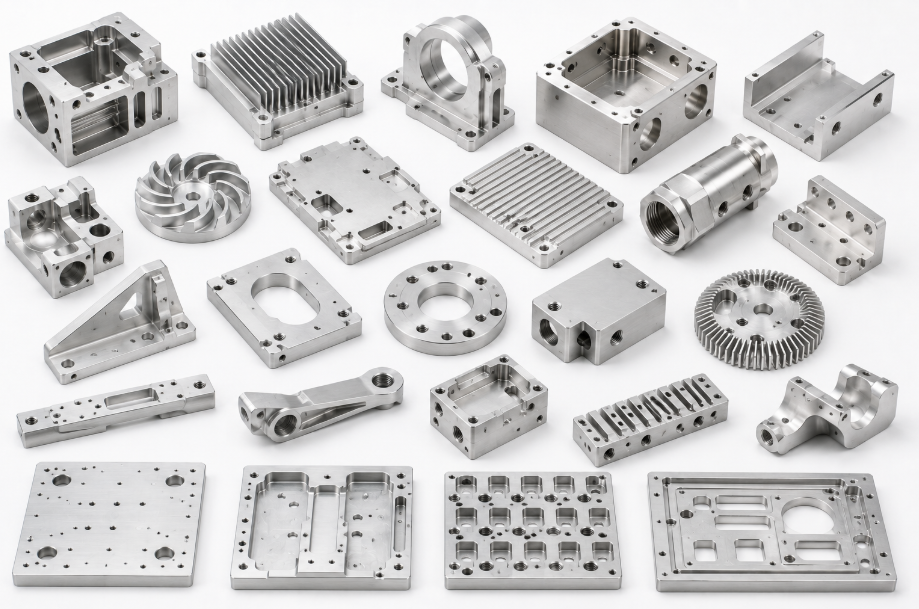
But "CNC machining services" covers a wide range of capabilities — different processes, materials, finishes and workflows — and understanding what's available helps you brief a supplier properly and get an accurate quote the first time.
This guide covers what CNC machining services typically include, the metals and plastics commonly available, the manufacturing workflow from RFQ to delivery, and what to prepare before requesting a quote.
What Do CNC Machining Services Include?
A full-service CNC machining supplier typically offers a combination of the following:
CNC Milling — for prismatic parts with flat faces, pockets, slots and contoured surfaces.
CNC Turning — for cylindrical parts such as shafts, bushings and threaded components.
Multi-axis machining, including 5 axis machining — for parts with complex geometry or features across multiple faces.
Secondary operations — drilling, tapping, boring, grinding and deburring.
Surface finishing — anodizing, plating, powder coating, passivation and bead blasting.
Quality inspection — dimensional checks against drawing tolerances, with reports or certificates of conformance where required.
Assembly and packaging — for parts that need to be assembled into sub-components or packaged to specific requirements before shipping.
Not every supplier offers every capability in-house — some outsource finishing or specialised processes — so it's worth confirming what is done internally versus subcontracted, particularly if lead time or quality traceability matters for your project.
Metal CNC Machining Capabilities
Metal is the most common material category for CNC machined parts, and the right choice depends on strength, weight, corrosion resistance and cost:
Aluminium — lightweight and easy to machine, ideal for enclosures, brackets and heat sinks. Common grades include 6061 and 7075.
Stainless Steel — corrosion-resistant and durable, used for fasteners, medical parts and food-grade equipment. Grades like 304 and 316 are common, with 17-4PH used where higher strength is needed.
Mild & Tool Steel — cost-effective for general structural parts (mild steel) or high-wear applications like dies and moulds (tool steel).
Brass — excellent machinability and conductivity, often used in fittings, connectors and decorative components.
Titanium — high strength-to-weight ratio for aerospace and medical applications, though slower and more expensive to machine.
Plastic CNC Machining Capabilities
Engineering plastics are machined using the same CNC processes as metal, and are chosen where weight, chemical resistance, electrical insulation or dimensional stability under specific conditions matter:
POM (Delrin) — high dimensional stability and low friction, used in gears, bushings and precision mechanical parts.
Nylon — tough and wear-resistant, suited to bushings and structural components.
PTFE — outstanding chemical resistance and a very low coefficient of friction, common in seals and gaskets.
PEEK — high-performance plastic with excellent strength, chemical and heat resistance, used in demanding industrial and medical applications.
PVDF — strong chemical and UV resistance, often used in fluid-handling components.
For a deeper look at material selection between these grades, see our dedicated Plastic Machining guide.
The CNC Manufacturing Workflow (From RFQ to Delivery)
A typical CNC machining project moves through several defined stages:
1. RFQ & DFM Review — the supplier reviews your CAD file and drawing, checking for features that are difficult or costly to machine, and confirms achievable tolerances.
2. Quoting — based on material, geometry, tolerance, finish and quantity, the supplier returns a price and lead time.
3. Programming — CAM software generates the toolpaths the CNC machine will follow, based on the part geometry and chosen process (milling, turning, multi-axis).
4. Machining — the part is cut from raw stock, with in-process checks to confirm dimensions are tracking to tolerance.
5. Finishing — secondary operations such as deburring, anodizing or plating are applied as specified.
6. Quality Inspection — finished parts are measured against the drawing, with a first-article inspection report typically provided for new parts or larger production runs.
7. Packaging & Delivery — parts are packaged appropriately (often with corrosion protection for metal parts) and shipped or delivered.
What to Include in Your RFQ for Accurate Quotes
The quality of a quote depends heavily on the information provided upfront. A complete RFQ should include:
A CAD file in a machining-friendly format (STEP is preferred) along with a 2D drawing showing critical dimensions and tolerances.
The material and, where relevant, the specific grade required.
Surface finish requirements, including any cosmetic or functional finishing.
Quantity required, and whether this is a one-off prototype or an ongoing production quantity.
Target lead time and any deadline constraints.
Any relevant quality or certification requirements (e.g. material certificates, inspection reports).
Providing this information upfront avoids back-and-forth clarification and results in a more accurate first quote.
Finishing Options for CNC Machined Parts
Finishing affects both appearance and function, and should be specified based on the part's end use:
Anodizing (Type II / Type III) — improves corrosion resistance and surface hardness on aluminium, and can add colour.
Powder Coating — a durable, decorative coating suitable for a wide range of metals.
Passivation — removes free iron from stainless steel surfaces to maximise corrosion resistance.
Bead Blasting — creates a uniform matte surface finish and can help mask minor tooling marks.
Plating (Zinc, Nickel, Chrome) — adds corrosion resistance or specific surface properties depending on the plating type.
Choosing the Right CNC Machining Partner
Beyond price, the most reliable indicators of a good CNC machining partner are clear DFM feedback before quoting, transparent communication on lead times, documented quality control, and the equipment capability to match your part's complexity — including access to Precision CNC Machining and 5 Axis Machining where your geometry requires it.
Sharing your CAD file and drawing is the fastest way to get a firm quote and confirm your supplier can meet your tolerance and finish requirements.
Frequently Asked Questions
Common questions about CNC machining services, quotes and production.
"CNC machining services" refers to the full range of milling, turning and related processes a supplier offers, while "precision CNC machining" specifically emphasises tight tolerance and repeatability requirements within those services. In practice, most CNC machining services are delivered to precision tolerances by default.
Most CNC machining suppliers can produce a single prototype part as well as production runs of thousands, since CNC processes don't require dedicated tooling in the way injection moulding does. Per-part cost typically decreases as quantity increases due to setup costs being spread across more units.
Lead time depends on part complexity, material availability, finishing requirements and current workshop capacity. Simple parts can often be turned around in a few days, while complex parts with multiple finishing steps may take several weeks.
Yes. CNC machining is well suited to both low-volume prototyping and higher-volume production, since the same programmed toolpaths can be reused across quantities without dedicated tooling.
A STEP file (.stp or .step) is the most widely accepted 3D format, along with a 2D drawing (PDF or DXF) showing critical dimensions, tolerances and any notes on material or finish.
Get a CNC Machining Quote
Upload your CAD file and drawing — our engineering team will review manufacturability and return a clear quotation for prototype or production volumes.